A practical guide for large infrastructure and PPP transactions
In a project finance transaction, undertakings are not boilerplate. They are the operating rules of the financing. Conditions precedent establish the basis on which lenders are prepared to fund. Representations test the position at signing, financial close, each utilisation and other repeating dates. Undertakings then govern how the project company, and in some cases the sponsors, shareholders, holding companies and support providers, must behave throughout the life of the debt.
This is especially important in limited recourse financings. Lenders are not underwriting a diversified corporate balance sheet. They are relying on one project, one contractual structure, one cash flow profile, the project assets, the project documents, the security package, the account structure, the insurance program, the reserve accounts and any sponsor support. The undertaking package is designed to preserve the bank case that was approved at financial close, prevent value leakage, preserve security, maintain the project company as a clean special purpose vehicle and ensure that warning signals reach the finance parties before value is impaired.
A well-drafted common terms agreement usually makes the undertakings continue until the senior debt has been repaid, the secured obligations have been discharged and the commitments have been cancelled. That duration point matters. Undertakings are not only construction period promises. They are life-of-loan controls.
1. What Are Undertakings?
An undertaking, often called a covenant, is a contractual promise by a project company, shareholder, sponsor or other obligor to do something, not do something, or provide information during the financing period.
Project finance undertakings generally fall into three categories:
| Category | What it does | Typical examples |
|---|---|---|
| Positive undertakings | Require the obligor to take specified actions | Maintain authorisations, comply with law, preserve security, construct and operate the project, maintain insurance, pay taxes, keep books and records, fund required reserve accounts |
| Negative undertakings | Restrict actions without consent or outside agreed baskets | No additional debt, no competing security, no disposals, no affiliate leakage, no restricted payments, no unauthorised amendments to project documents, no change in business |
| Information undertakings | Keep lenders informed and able to monitor risk | Financial statements, management accounts, construction reports, operating budgets, operating reports, ratio calculations, default notices, insurance claims, project document disputes |
The reason undertakings are central is simple. A project company normally exists for one project and has limited external value if that project fails. Lenders therefore need ongoing control over the project company's cash, assets, contracts, permits and risk profile.
2. The Undertaking Package Starts With the SPV Concept
The foundation of bankability is the single-purpose project company. The borrower should remain a clean SPV whose assets, liabilities and business are limited to the financed project and matters incidental to it.
Typical SPV undertakings require the project company to maintain its legal existence, preserve its corporate status, hold the power to own its assets and conduct the project business, and avoid activities outside the project. A strong package will restrict the project company from:
- carrying on any business other than the project,
- owning assets that are unrelated to the project,
- incurring financial indebtedness except permitted debt,
- granting security except permitted security,
- making investments other than authorised short-term investments,
- entering into non-project contracts except permitted contracts,
- merging, reorganising, acquiring businesses or changing constitutional documents without the required consent,
- making loans or guarantees except in narrowly defined circumstances.
This keeps the borrower structurally clean. Lenders do not want the project cash flow to be exposed to creditors, claims or business risks that were not part of the approved financing case.
In transactions with offshore holding companies, bid holding companies or intermediate holding companies, the same logic may extend above the project company. Lenders may require holding entities to remain special purpose vehicles, avoid third-party debt, hold only permitted assets, and grant share security in jurisdictions where enforcement is workable.
3. Authorisations, Permits and Compliance With Law
Large infrastructure and PPP projects are authorisation-heavy. They may require concessions, licences, construction permits, environmental approvals, land rights, operating permits, sector approvals, foreign ownership clearances, corporate approvals and finance document filings.
A standard authorisations undertaking requires the project company to obtain, maintain, comply with and provide copies of all material authorisations required for the project and for the finance documents. The covenant should cover three separate risks:
- the legality of the project,
- the ability of the company to perform the project documents and finance documents,
- the validity, enforceability and admissibility in evidence of the finance documents and security documents.
The authorisation covenant is broader than a general compliance with law undertaking. A missing licence can stop construction, block operation, interrupt revenues, prevent enforcement or trigger termination under a project document. For lenders, loss of a key permit can be as serious as a missed payment.
Drafting should avoid two common weaknesses. First, the covenant should not be limited only to authorisations known at financial close. It should also capture future authorisations required as the project develops. Second, materiality should be calibrated carefully. A broad material adverse effect qualifier may be appropriate for immaterial permits, but core concessions, land rights, environmental approvals and revenue permits often need tighter treatment.
4. Construction and Completion Undertakings
During construction, lenders are exposed to completion risk. They need the project built on time, within budget, to the required technical standard and in accordance with the revenue contract, EPC contract, permits and base case assumptions.
Typical construction undertakings require the project company to procure design, engineering, procurement, construction, commissioning, testing and completion with due care and diligence and in accordance with the EPC contract and other project documents. A bankable package also connects construction undertakings to drawdown mechanics, cost reporting and independent technical review.
| Construction undertaking | Purpose |
|---|---|
| Build in accordance with the EPC contract and project documents | Keeps construction aligned with the banked technical and contractual case |
| Deliver periodic construction reports | Gives lenders visibility on progress, delays, claims and emerging risks |
| Maintain and update the construction budget | Controls scope, line items and contingency usage |
| Use utilisations only for approved project costs | Prevents leakage of debt proceeds |
| Provide cost certificates and technical adviser confirmations | Gives lenders independent validation before funding |
| Maintain a cost-to-complete test | Ensures remaining committed sources are sufficient to finish the project |
| Notify delays, force majeure, variations and disputes | Allows early intervention before value deteriorates |
| Control variations and change orders | Prevents unapproved scope drift and funding shortfalls |
Drawdown conditions commonly require no default, true repeating representations, evidence that requested amounts are due, confirmation by the lenders' technical adviser, and a cost-to-complete test showing available funding is not less than remaining completion costs.
For financial modelers, the lesson is direct. The construction model must test availability period cut-offs, permitted project costs, equity draw timing, cost-to-complete headroom, contingency usage, reserve funding, completion longstop dates and technical adviser sign-off points. A sources and uses page alone is not enough.
5. Operating and Maintenance Undertakings
After commercial operation, the risk profile shifts from completion to performance. Lenders monitor whether the project is operating to the availability, cost, maintenance, lifecycle and revenue assumptions in the base case.
A typical operation and maintenance undertaking requires the company to operate, maintain and repair the project:
- in accordance with the O&M agreement and project documents,
- in accordance with good industry practice or the standard of a reasonable and prudent operator,
- in compliance with law, permits, environmental requirements and insurance requirements,
- within approved operating budgets, subject to agreed exceptions,
- without materially reducing the useful life, performance capacity or availability of the project.
Operating undertakings should connect to reporting. A finance document may require periodic operating reports showing performance against budget, maintenance performed, defects, malfunctions, outages, revenues, operating costs, budget variances and explanations for material deviations.
Operating budgets should also be controlled. Lenders usually accept that the project company must pay genuine operating costs. However, they will want limits on unapproved overspending, related-party charges, major maintenance costs and material contract changes. The model should therefore compare actual operating costs against approved budget and flag any variance that requires consent, lender review or expert determination.
6. Financial Information, Forecasts and the Financial Model
Project finance lenders do not monitor the borrower only through audited accounts. They monitor the project through forward-looking forecasts, ratio tests, construction reports, operating budgets, operating reports and model updates.
Typical financial information undertakings include:
| Deliverable | Typical frequency or trigger | Why it matters |
|---|---|---|
| Audited financial statements | Annually | Confirms accounting position |
| Management accounts | Monthly, quarterly or semi-annually | Provides early warning on performance |
| Construction reports | During construction | Tracks cost, schedule, progress and claims |
| Operating budgets | Annually, with updates if needed | Sets permitted operating spend |
| Operating reports | Periodically after operation starts | Compares actual performance to budget |
| Updated project forecasts | On calculation dates or trigger events | Tests future cash flow and ratios |
| Ratio statements | On scheduled and additional calculation dates | Certifies covenant and lock-up compliance |
| Notices of default or material events | Promptly | Preserves lender response rights |
The financial model should be controlled. A common terms agreement may allow model amendments to correct manifest errors, determine LLCR, or improve forecast accuracy, but changes should be subject to lender approval or expert determination if the parties cannot agree.
This is critical. In project finance, the model is not just an internal analysis tool. It often becomes a contractual reference point. DSCR, projected DSCR, LLCR, distributions, reserve accounts, drawdowns, prepayments, lock-up triggers and defaults may all depend on model outputs. A model that uses a lender-unapproved definition can be technically sophisticated and still not be bankable.
7. DSCR, Projected DSCR, LLCR and Financial Ratio Controls
Financial ratios are central to project finance undertakings, but they must be drafted with precision. A ratio is not useful unless the agreement states exactly when it is tested, how it is calculated and what happens if it is not satisfied.
The main ratio controls are:
| Ratio control | What it measures | Typical use |
|---|---|---|
| Historic DSCR | Actual cash flow available for debt service over a completed period divided by debt service for that same period | Distribution lock-up, cash sweep, default floor, equity cure |
| Projected DSCR | Forecast cash flow available for debt service for one or more future DSCR periods divided by forecast debt service for those same periods | Distribution lock-up, partial distribution, cash trap, downside monitoring |
| LLCR | Discounted projected cash flow available for debt service over the remaining loan life, often plus eligible reserve balances, divided by outstanding senior debt | Debt sizing, distribution lock-up, default floor, refinancing and prepayment analysis |
Historic DSCR is backward-looking. It tests whether the project generated enough cash in a completed period to cover debt service for that period. The agreement should define the test period, the numerator, the denominator, the treatment of reserves, hedge receipts, taxes, working capital, extraordinary receipts and disputed revenues.
Projected DSCR is forward-looking. It tests whether the current forecast shows adequate cover for future debt service. The agreement should specify the number of future periods tested, the forecast assumptions used, the calculation date, whether the test uses the current project forecast or a base case update, and whether each future period must pass individually.
LLCR is a life-of-loan metric. It compares discounted future cash flow over the remaining loan life with outstanding senior debt. The agreement should define the discount rate, projected cash flow period, reserve account treatment, debt amount, model assumptions and expert determination process for disputed assumptions.
A well-drafted ratio package should answer these questions:
- Is the ratio historic, projected, or both?
- Is the test date scheduled, event-driven, or both?
- What is the calculation period for each test?
- Is available cash flow calculated on a cash basis?
- Are reserve withdrawals included, excluded, or included only if contractually permitted?
- Are disputed revenues excluded until admitted, received or legally unconditional?
- Are hedge receipts netted against debt service, and are hedge termination payments excluded?
- Are forecast assumptions fixed, updated, agreed, or subject to expert determination?
- Is the consequence a distribution lock-up, cash sweep, equity cure, mandatory prepayment, event of default, or acceleration right?
- Are the lock-up threshold and default threshold different?
The consequences should never be vague. The finance documents should say, for each ratio and each threshold, whether failure merely blocks distributions, traps cash, triggers a sweep, allows an equity cure, creates an event of default, or allows acceleration. A projected DSCR distribution test, a historic DSCR default floor and an LLCR lock-up test are different controls and should not be merged into a single unclear covenant.
Thresholds are transaction-specific. Availability-based PPPs, merchant power projects, renewable projects, water projects and transport concessions may all use different ratio levels and consequences. A publishable article should avoid implying that any ratio threshold is universal.
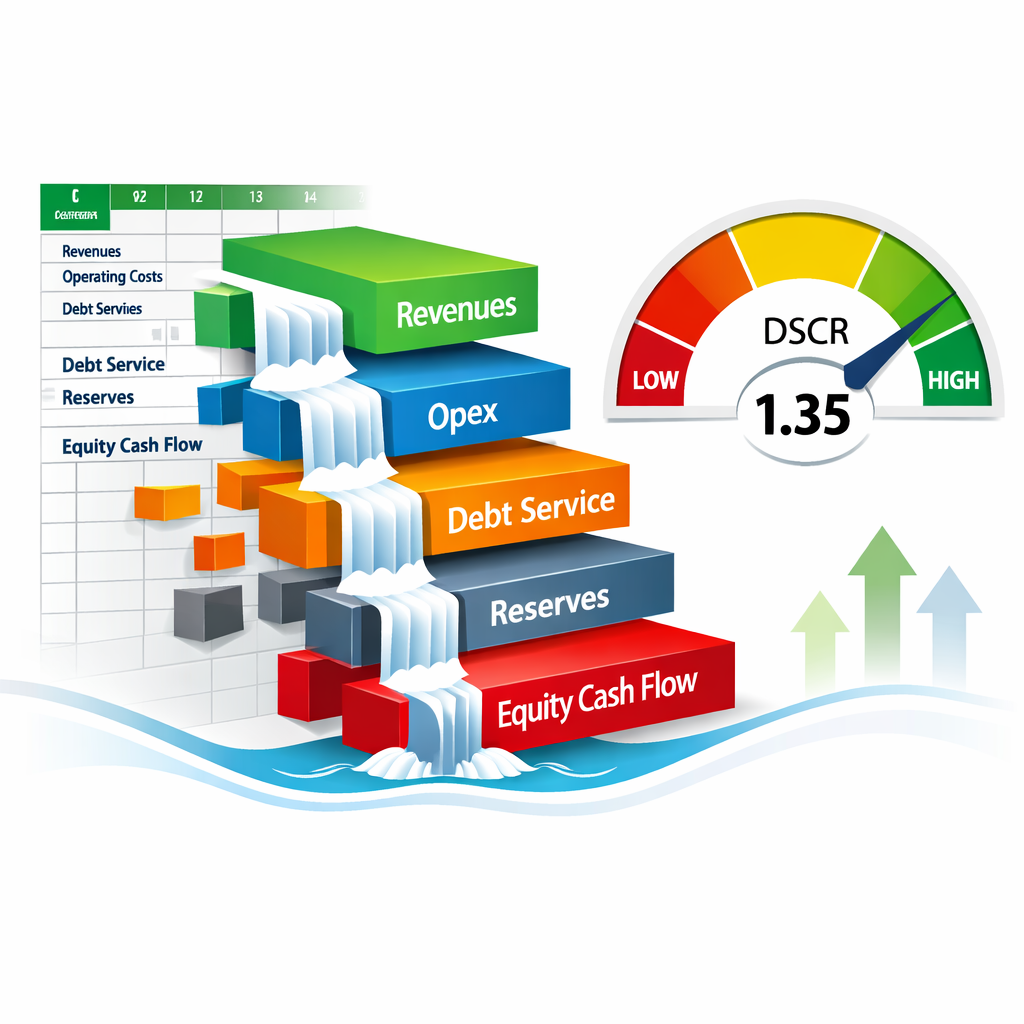
8. Project Accounts and the Cash Waterfall
Project finance is cash-controlled finance. Revenues, financing proceeds, reserve funding and compensation receipts should be paid into the correct controlled accounts and applied through the contractual waterfall. The account structure is one of the main ways lenders convert limited recourse into practical control.
The first drafting point is terminology. Project Accounts is normally a defined term and should not be used loosely to mean every bank account in the transaction unless the agreement expressly says so. In the reviewed common terms agreement, the defined Project Accounts are:
- Revenue Account,
- Proceeds Account,
- Debt Service Payment Account,
- Debt Service Reserve Account,
- Major Maintenance Reserve Account,
- Compensation Proceeds Account.
This confirms the correct treatment: the Proceeds Account is one specific Project Account. It is not a generic label for all accounts that receive proceeds. In the reviewed common terms agreement, the Proceeds Account receives the proceeds of all loans and the proceeds from the on-sale of commodities purchased under the Murabaha facility. Withdrawals from the Proceeds Account are limited to specified uses, including repayment of existing debt, payment of approved new plant costs and, until completion, funding the DSRA up to the DSRA target balance. Once the final new plant costs have been paid, the Proceeds Account is closed and any remaining balance is transferred to the Revenue Account.
The Compensation Proceeds Account is a separate Project Account. It receives capital compensation and, subject to the insurance provisions, certain third-party and employers' liability insurance proceeds. Withdrawals from that account are governed by the reinstatement, mandatory prepayment, third-party payment and financial ratio provisions. It should not be called the Proceeds Account and should not be modelled as a reserve unless the finance documents expressly require a funded target balance.
Some transactions also maintain controlled accounts outside the defined Project Accounts. In the reviewed common terms agreement, the Rehabilitation Escrow Account and the Distributions Account are maintained and controlled alongside the Project Accounts, but they are not included in the defined list of Project Accounts. The drafting and the model should therefore follow the defined account taxonomy in the finance documents exactly.
A typical controlled account structure may be summarised as follows:
| Account | Core function | Drafting focus |
|---|---|---|
| Proceeds Account | Receives only the facility proceeds or other funding receipts that the finance documents expressly require to be credited to that account. In the reviewed common terms agreement, this means loan proceeds and Murabaha on-sale proceeds, not all proceeds generally. | Permitted inflows, permitted project costs, refinancing payments, initial DSRA funding where expressly permitted, closure and transfer of residual balances |
| Revenue Account | Receives operating revenues and residual amounts not required to be credited elsewhere | Revenue capture, operating costs, debt service funding, reserve top-ups and distribution transfer tests |
| Debt Service Payment Account | Accumulates amounts for scheduled debt service | Timing of transfers, interest, profit, fees, principal, scheduled reductions and payment priority |
| Debt Service Reserve Account | Provides liquidity support for scheduled debt service shortfalls | Target balance, permitted support instruments, draws, top-ups and excess release |
| Major Maintenance Reserve Account or lifecycle reserve | Funds major maintenance, lifecycle works, overhaul or spares | Funding triggers, required balance, technical adviser review and permitted withdrawals |
| Compensation Proceeds Account | Holds capital compensation and specified insurance or compensation receipts required by the finance documents to be credited to that account | Reinstatement, third-party liability payment, mandatory prepayment, financial ratio provisions, transfer to revenue, cash sweep or permitted release mechanics |
| Rehabilitation, decommissioning or handback account, where applicable | Funds concession handback, rehabilitation, reinstatement or decommissioning obligations | Required balance, public authority requirements, permitted use and release conditions |
| Distributions Account | Receives amounts permitted to be distributed after lock-up conditions are met | Distribution conditions, timing, shareholder payments and subordination controls |
The key undertaking is that the project company may open and operate only permitted accounts, deposit each receipt into the correct account, and withdraw funds only as expressly permitted by the finance documents. Account protections typically include no overdrawing, separate account maintenance, lender access to records, restrictions during default, and an account bank waiver of set-off and combination rights.
A typical pre-enforcement waterfall might apply revenue in this order:
| Priority | Payment or transfer |
|---|---|
| 1 | Taxes, permitted operating costs and approved project costs |
| 2 | Senior fees, costs and expenses |
| 3 | Scheduled interest, profit or financing costs |
| 4 | Scheduled principal or commitment reductions |
| 5 | Hedge payments, where applicable |
| 6 | Rehabilitation, handback or decommissioning account funding, where applicable |
| 7 | DSRA top-up |
| 8 | Maintenance or lifecycle reserve top-up |
| 9 | Mandatory prepayments or permitted voluntary prepayments |
| 10 | Transfer to the Distributions Account, only after lock-up conditions are satisfied |
The waterfall should distinguish pre-enforcement priorities from post-enforcement recoveries. Before enforcement, the objective is operational continuity and scheduled debt service. After enforcement, recoveries are usually applied through a different enforcement waterfall.
9. Reserve Accounts, Proceeds Account and Compensation Proceeds Account
Reserve accounts, the Proceeds Account and the Compensation Proceeds Account should not be confused. Each performs a different role in a bankable account structure and each should be modelled according to its defined purpose.
A reserve account is funded to meet a future obligation or liquidity risk. It usually has a target balance, top-up requirement, permitted withdrawal rules and release mechanics. The Proceeds Account is not a reserve. It is one specific Project Account, where used and defined, for facility proceeds or other funding receipts expressly credited to that account. It is not a generic umbrella for all receipts. Equity contribution proceeds should be routed through the account expressly stated in the finance documents, often an equity account, disbursement account or construction account, and should not be assumed to pass through the Proceeds Account. The Compensation Proceeds Account is also not a reserve unless the finance documents expressly create a funded target balance. It is a separate Project Account for capital compensation and specified insurance or compensation receipts pending their contractual application.
The most common true reserve accounts are:
| Account | Function | Key drafting points |
|---|---|---|
| Debt Service Reserve Account, DSRA | Provides liquidity for scheduled senior debt service shortfalls | Target balance, funding date, eligible letters of credit, draw mechanics, top-up, excess release, replacement of expiring or downgraded support |
| Maintenance or lifecycle reserve | Funds major maintenance, overhaul, lifecycle works or spare parts | Trigger events, target balance, operating budget link, technical adviser review, permitted withdrawals, release conditions |
| Rehabilitation, decommissioning or handback account, where applicable | Funds reinstatement, decommissioning, rehabilitation or handback obligations required by a concession or project document | Funding profile, required balance, permitted use, interface with public authority requirements, release at expiry or transfer |
| Working capital or operating reserve, where applicable | Retains minimum operating liquidity | Minimum balance, period of costs covered, interaction with distributions and waterfall |
The Proceeds Account and the Compensation Proceeds Account should be drafted separately from true reserves and from each other:
| Account | What it captures | Why it matters |
|---|---|---|
| Proceeds Account | Facility proceeds and other specified funding receipts expressly credited to that account, such as loan proceeds, Murabaha on-sale proceeds or disbursement proceeds if the transaction uses that structure | Controls source-and-use discipline for approved project costs, refinancing payments, construction funding, initial DSRA funding where permitted, closure and residual balance treatment |
| Compensation Proceeds Account | Capital compensation, specified physical damage insurance proceeds, expropriation compensation, termination payments and other compensation receipts expressly credited to that account | Determines whether receipts are used for repair or reinstatement, third-party liabilities, mandatory prepayment, financial ratio provisions, transfer to revenue, cash sweep or permitted release. Disposal proceeds, hedge close-out receipts, liquidated damages and other exceptional receipts should be routed under their own provisions unless the agreement expressly directs them to this account. |
The distinction matters in the financial model. True reserves require target balance calculations, funding schedules, top-ups, drawings and releases. The Proceeds Account requires source-and-use tracking, permitted withdrawal logic and residual balance treatment. The Compensation Proceeds Account requires receipt-specific routing and application rules. Other exceptional receipts require their own routing logic. Exceptional receipts such as disposal proceeds, performance liquidated damages, hedge close-out receipts and policy-trigger proceeds should be routed through their own contractual provisions unless the agreement expressly places them into a defined account. Treating the Compensation Proceeds Account as a reserve, or treating the Proceeds Account as a generic umbrella for all receipts, can misstate available cash, reserve funding, mandatory prepayment and distribution capacity.
10. Insurance Undertakings
Insurance undertakings protect the physical asset, the revenue stream and the repayment profile. In major projects, the covenant should go beyond a simple promise to maintain insurance.
A bankable insurance package usually requires the project company to:
- maintain required construction and operational policies,
- name the lenders, security agent or finance parties where appropriate,
- comply with the insurance schedule and insurance adviser recommendations,
- ensure policies include agreed lender clauses, loss payee provisions and non-vitiation protections where available,
- pay premiums on time,
- notify material claims, cancellation, suspension and material changes in cover,
- deliver broker undertakings and notices of assignment,
- apply proceeds to reinstatement, third-party liabilities, revenue accounts or mandatory prepayment as required,
- maintain reinsurance, cut-through or assignment arrangements where relevant.
Insurance proceeds and capital compensation must be integrated with the cash waterfall and mandatory prepayment provisions. If proceeds are needed and permitted for reinstatement, the documents should control how they are released. If they are not used for reinstatement, they may be required to prepay debt. Delay in start-up and business interruption proceeds are often treated differently from physical damage proceeds because they replace revenue rather than capital assets.
11. Negative Undertakings, Preventing Leakage and Structural Drift
Negative undertakings stop the project company from changing the deal that lenders approved. They are particularly important because a project finance borrower has little margin for unrelated risk.
| Negative undertaking | Why lenders require it |
|---|---|
| Negative pledge | Prevents competing security over project assets |
| Financial indebtedness restriction | Preserves leverage and repayment assumptions |
| Disposal restriction | Preserves the project asset base and revenue stream |
| Acquisition and investment restriction | Keeps the company single-purpose |
| Loan and guarantee restriction | Prevents the company from supporting third-party credit risk |
| Affiliate transaction restriction | Prevents value transfer to sponsors or related parties |
| Project document amendment restriction | Preserves the contractual risk allocation and revenue case |
| New material contract restriction | Prevents new liabilities or operating complexity |
| Treasury transaction restriction | Prevents speculative hedging or unapproved derivatives |
| Distribution restriction | Prevents leakage before senior debt protections are met |
| Merger and reconstruction restriction | Preserves identity, security and insolvency profile |
The drafting should distinguish prohibited actions from permitted baskets. Baskets may be needed for ordinary-course disposals, obsolete asset replacement, permitted encumbrances, authorised investments, project document requirements and minor financial indebtedness. The point is not to freeze the project company commercially. It is to ensure any material change to the risk profile requires lender consent or falls within an agreed exception.
12. Distribution Lock-Up Undertakings
Distribution controls are one of the most important protections in the finance documents. They decide when value can leave the ring-fenced project structure.
A robust distribution lock-up requires that distributions be made only from the Distributions Account, and only after all applicable conditions are met. Typical conditions include:
- completion or final cost confirmation has occurred,
- a minimum operating seasoning period has passed, where required,
- the first repayment date has occurred and amounts due have been paid,
- no default, policy trigger or insurer trigger is continuing or would result,
- the borrower has delivered advance notice, calculations and supporting information,
- historic DSCR is at or above the required distribution threshold,
- LLCR is at or above the required distribution threshold,
- projected DSCR for the required future test periods is at or above the required distribution threshold,
- DSRA is fully funded, including eligible DSRA letter of credit support where permitted,
- maintenance or lifecycle reserve is fully funded to the required level,
- required rehabilitation, decommissioning or handback reserve is funded, where applicable,
- minimum working capital or operating account balance is retained, where required,
- the distribution is lawful and does not breach project documents or finance documents.
The lock-up should be modelled as a hard gate, not as a post-processing adjustment. The model should test every condition before any cash is moved to the distributions account. This is where legal drafting and financial modelling often fail to align. If the model distributes all free cash flow but the finance documents impose lock-up conditions, the model overstates shareholder value.
Some sophisticated financings permit partial distributions where forward-looking projected DSCR is below the normal distribution threshold, but only if a portion of cash remains locked up so that the projected ratio is cured. That is an advanced feature and should be modelled transparently.
13. Hedging and Treasury Undertakings
Hedging undertakings depend on the debt structure. Where senior debt is floating rate, lenders may require the project company to enter into interest rate swaps or other hedging arrangements with acceptable hedge providers.
Typical hedging controls cover:
- minimum hedged percentage of floating-rate exposure,
- maximum hedged percentage to prevent over-hedging,
- acceptable hedge providers and minimum credit ratings,
- downgrade triggers and replacement obligations,
- alignment of hedge payment dates with debt service dates,
- treatment of hedge receipts and hedge termination payments,
- restrictions on speculative derivatives,
- security and intercreditor treatment of hedge liabilities.
In some transactions, the borrower is required to hedge. In others, the borrower is prohibited from entering into treasury transactions except those permitted by the finance documents. Either way, the policy is the same. Hedging should reduce financing risk, not create speculative exposure or unapproved liabilities.
14. Shareholder, Equity and Sponsor Undertakings
Project finance undertakings do not stop at the borrower. Lenders also care about who owns the project, who funds equity, and whether shareholder claims are subordinated.
Typical shareholder and sponsor undertakings include:
- base equity contribution obligations,
- standby equity or cost overrun support,
- letters of credit, corporate guarantees or parent guarantees supporting equity commitments,
- equity bridge loan repayment requirements,
- subordination of equity bridge, shareholder loan and sponsor claims,
- restrictions on payment of subordinated debt interest or principal until distribution conditions are met,
- share retention undertakings during construction or for a defined post-completion period,
- restrictions on transfers of shares and shareholder loans,
- accession requirements for transferees,
- maintenance of security over shares and shareholder loans,
- know-your-customer, legal opinion and credit support conditions for permitted transfers.
Shareholder agreements can also include project-relevant controls that support bankability, such as capital contribution procedures, remedies for failure to contribute, transfer restrictions, governance approval rights, annual budget approval, bank account controls, information rights and related-party transaction controls.
The finance documents and shareholder documents should be aligned. If the shareholders' agreement permits a transfer, dividend, subordinated loan repayment or related-party transaction that the finance documents prohibit, the project company may face conflicting obligations. Bankable drafting resolves that conflict by subordinating shareholder economics and transfer rights to the senior finance documents.
15. Environmental, Social and Policy Undertakings
International infrastructure financings often include undertakings driven by export credit agencies, development finance institutions, political risk insurers or covered lenders. These may include environmental and social requirements, anti-corruption obligations, sanctions, procurement requirements, local law compliance, ownership conditions and reporting obligations.
The important drafting point is to distinguish ordinary defaults from policy trigger events. A policy trigger may give a particular lender or insurer cancellation, prepayment, cash sweep or acceleration rights, sometimes without the same majority-lender process that applies to ordinary defaults.
Typical policy-related controls may include:
- compliance with lender or insurer environmental and social requirements,
- accuracy of environmental and social representations,
- notice of environmental claims or material remedial action,
- maintenance of specified sponsor ownership or nationality requirements,
- evidence of paid-up equity or minimum equity contribution by a target date,
- additional reporting to covered lenders or insurers,
- cash sweep or mandatory prepayment following defined policy triggers.
These undertakings should not be treated as boilerplate. They can materially affect transferability, enforcement strategy, prepayment risk and distribution capacity.
16. Events of Default, The Enforcement Backbone
Undertakings matter because breach has consequences. The events of default clause turns selected covenant failures into lender remedies.
A typical default framework distinguishes:
| Breach type | Typical consequence |
|---|---|
| Non-payment | Short grace period, then event of default |
| Breach of core negative undertakings | Often immediate default or very limited cure |
| Breach of reporting undertakings | Cure period if capable of remedy |
| Breach of other undertakings | Cure period, often conditional on diligent remediation |
| Security failure | Default if priority, validity or enforceability is impaired and not cured |
| Loss of material authorisation | Default if material to the project or finance documents |
| Project document termination or material breach | Default if it threatens the project, revenue or lender position |
| Insolvency or creditor process | Event of default, sometimes with replacement rights for key counterparties |
| Ratio failure | Lock-up, cash sweep, equity cure or default, depending on the ratio and threshold |
| Policy trigger | Lender or insurer-specific rights, which may include sweep, cancellation or acceleration |
A well calibrated package gives lenders early escalation rights without turning every administrative breach into immediate acceleration. Key negative covenants should be strict. Remediable reporting or administrative failures may justify cure periods. Ratio failures should be mapped carefully to lock-up, cash sweep, cure and default thresholds.
17. Practical Drafting Checklist
A strong undertaking package should answer the following questions:
| Area | Drafting question |
|---|---|
| Duration | Do undertakings continue until all secured obligations are discharged and commitments are cancelled? |
| Obligors | Which obligations apply to the project company, sponsors, shareholders, holding companies and support providers? |
| SPV status | Is the project company prevented from unrelated business, assets, debt, guarantees and investments? |
| Authorisations | Are all material permits, concessions, land rights and finance-document approvals covered? |
| Construction | Are budget, cost-to-complete, technical adviser and variation controls included? |
| Operation | Are O&M standards, operating budgets, reporting and prudent-operator exceptions properly drafted? |
| Information | Are financial statements, project reports, forecasts, ratio calculations and notices delivered on time? |
| Model | Are model changes controlled and subject to approval or expert determination? |
| Accounts | Are all project accounts controlled, separate, non-overdrawn and protected from set-off? |
| Waterfall | Is every permitted payment and transfer clearly ranked? |
| Reserves | Are DSRA, maintenance or lifecycle reserves, and any rehabilitation, decommissioning or handback reserves calculated, funded, topped up, drawn and released correctly? |
| Proceeds Account | Is the defined Proceeds Account clearly treated as one Project Account for facility proceeds or other expressly specified funding receipts, with withdrawals limited to permitted purposes? |
| Compensation Proceeds Account and exceptional receipts | Are capital compensation, insurance proceeds and other exceptional receipts routed to the correct account or waterfall line, without misclassifying the Compensation Proceeds Account as a reserve or treating the Proceeds Account as an umbrella account? |
| Insurance | Are policies, insured parties, loss payee clauses, broker undertakings, claims and proceeds mechanics complete? |
| Financial ratios | For historic DSCR, projected DSCR and LLCR, are the calculation dates, test periods, numerator, denominator, forecast assumptions, permitted adjustments, cure rights and consequences clearly stated? |
| Consequences | Does each ratio threshold state whether the result is distribution lock-up, cash trap, cash sweep, equity cure, mandatory prepayment, event of default or acceleration? |
| Distributions | Are lock-up tests comprehensive and automated in the financial model? |
| Negative covenants | Are debt, security, disposals, affiliates, project documents, treasury and new material contracts restricted? |
| Hedging | Are hedge quantum, provider rating, downgrade and termination mechanics controlled? |
| Equity | Are equity contributions, shareholder loans, support instruments and subordination enforceable? |
| Share retention | Are transfer restrictions, accession requirements and share security preserved? |
| Policy triggers | Are ECA, insurer, environmental, ownership and sanctions requirements separately addressed? |
| Defaults | Are breaches mapped to suitable cure periods, lock-up, sweep and acceleration rights? |
18. Modelxcel Perspective, What Financial Modelers Should Build
For financial modelers, undertakings should be converted into model logic. A bankable model should not only forecast cash. It should forecast what the finance documents permit.
A project finance model should include:
- sources and uses controls, showing whether each funding source is used only for permitted costs,
- availability period checks, ensuring no facility is drawn after the contractual cut-off date,
- equity funding logic, including pro rata debt-equity drawing, back-ended equity or equity bridge mechanics,
- cost-to-complete tests, comparing remaining project costs with available funding,
- construction budget variance tests, including line-item and aggregate thresholds,
- debt service calculations, including interest, profit, fees, principal, hedge payments and tax gross-up where relevant,
- historic DSCR, projected DSCR and LLCR calculations that match finance document definitions,
- reserve account schedules for DSRA, maintenance or lifecycle reserves and, where applicable, rehabilitation, decommissioning or handback reserves,
- Proceeds Account logic for facility proceeds, permitted withdrawals, initial DSRA funding where expressly permitted, closure and residual balance treatment,
- Compensation Proceeds Account logic for capital compensation and specified insurance or compensation receipts, plus separate routing for disposal proceeds, hedge close-out receipts, liquidated damages and other exceptional receipts,
- support instrument logic, including letters of credit, expiry, replacement and eligible balance treatment,
- pre-enforcement cash waterfall in the exact contractual order,
- distribution lock-up tests and partial distribution mechanics where applicable,
- mandatory prepayment logic for insurance proceeds, compensation proceeds, disposals, hedge close-out receipts, reserve releases and policy triggers,
- default and lock-up flags, separating events of default from distribution blocks and cash sweep triggers,
- shareholder loan and subordinated payment restrictions,
- sensitivity outputs showing which undertaking is constraining distributions or debt service resilience.
The best models do not merely forecast dividends. They forecast whether dividends are legally permitted.
Conclusion
Typical undertakings in a project finance agreement are designed to preserve the lender-approved risk profile from financial close to final repayment. They keep the borrower single-purpose, preserve authorisations, protect security, control accounts, enforce the waterfall, maintain true reserves, treat the Proceeds Account as one defined Project Account, distinguish Compensation Proceeds Account mechanics, monitor ratios, restrict leakage, preserve project documents and create early warning rights.
For sponsors, undertakings can feel restrictive. For lenders, they are the core of limited recourse credit protection. For modelers, they are the bridge between legal documentation and financial outputs.
A project finance agreement is bankable when its undertakings, Project Accounts, reserve accounts, Proceeds Account mechanics, Compensation Proceeds Account mechanics, ratios, distributions, prepayment mechanics and default regime operate as one integrated system. A project finance model is bankable only when it reflects that system faithfully, including the distinction between true reserves, funding accounts and exceptional receipt accounts.
Chief Financial Officer & CPA (Inactive). Empowering financial professionals with tools, knowledge, and resources to excel.
LinkedIn