Islamic financing has become a major component of modern project finance, particularly in infrastructure, energy, transport, water, and social infrastructure. This article explains how Shari'a compliant structures, especially murabaha, can operate within bankable project finance frameworks supported by common terms, cash flow controls, covenant discipline, and enforceable security.
Islamic financing has become an established and increasingly sophisticated feature of the global project finance market. Across sectors such as energy, infrastructure, transport, water, healthcare, and social infrastructure, Shari'a compliant structures are now regularly used to support large and complex projects.
This growth reflects a clear commercial reality. Islamic financing is no longer a specialist alternative operating at the margins of the market. When properly structured, it can sit within the same disciplined project finance framework that conventional financiers expect, supported by ring-fenced cash flows, contractual risk allocation, covenant protection, and enforceable security.
What Is Islamic Financing in Project Finance?
Project finance is a method of financing a specific project through the future cash flows it is expected to generate. The financing is typically advanced to a special purpose project company, with lenders relying primarily on the project's assets, contracts, and revenue profile rather than the wider balance sheets of the sponsors.
Islamic finance differs from conventional lending because it does not permit interest-based returns. Instead, financing must be linked to real assets, trade, services, or investment activity. In a project finance context, this means the funding must be structured through Shari'a compliant contractual arrangements while still preserving the commercial features required for bankability.
Shari'a law prohibits riba — the receipt or payment of interest. This does not prevent financing. It requires financing to be structured through trade, asset ownership, leasing, or partnership arrangements that generate a lawful return linked to real economic activity rather than to the mere passage of time.
Why Islamic Financing Fits Naturally with Project Finance
Islamic finance and project finance share several structural characteristics that make them natural complements rather than competing disciplines.
Real Asset and Cash Flow Focus
Lenders rely on a defined asset base, contractual frameworks, and predictable project revenues. Returns are tied to actual project performance and economic output, not the balance sheets of the sponsors.
Asset-Backed, Trade-Linked Returns
Financing must be linked to real assets, trade, or investment activity. Returns are derived from ownership, services rendered, or deferred sales — not from lending at interest.
Both frameworks place strong emphasis on payment discipline, clearly defined rights and obligations, and effective risk allocation. This makes Islamic financing particularly suitable for projects with identifiable assets, stable contractual frameworks, and predictable cash flows.
In practice, Islamic financing can support many of the same assets commonly financed with conventional debt, including power plants, renewable energy projects, roads, ports, airports, desalination plants, hospitals, and industrial facilities.
The most active sectors globally include energy and power generation, renewable infrastructure, transport corridors, water and wastewater treatment, social infrastructure such as hospitals and schools, and large-scale industrial facilities. The common thread is long-term, asset-backed cash flows supported by strong contractual frameworks.
Common Islamic Financing Structures
Murabaha: The Most Widely Used Structure
One of the most widely used Islamic structures in project finance is murabaha — a cost-plus deferred sale arrangement that creates financing liquidity without resorting to interest-based lending.
Although the commercial effect may resemble conventional debt financing, the legal structure is based on trade and deferred payment rather than lending at interest. This distinction is both legally significant and commercially meaningful for institutions that may only participate through Shari'a compliant arrangements.
Murabaha remains popular because it is familiar, operationally established, and capable of fitting within complex syndicated financings. However, it requires careful structuring and disciplined execution, particularly in relation to transaction sequencing, title transfer mechanics, and agency arrangements.
Murabaha requires precise sequencing. The financier must acquire title to the assets before selling them to the project company — not simultaneously, and not after. Any failure in sequencing or transfer mechanics can compromise the Shari'a compliance of the transaction. This is why legal counsel and Shari'a advisers must work closely together throughout the structuring process.
Other Shari'a Compliant Structures
While murabaha dominates the project finance market, other Islamic structures are also used depending on the asset profile, project phase, and jurisdiction:
| Structure | Basis | Typical Use Case |
|---|---|---|
| Murabaha | Cost-plus deferred sale | Commodity-based liquidity for general project purposes |
| Ijara | Leasing arrangement | Long-term equipment or asset financing during operations |
| Istisna | Forward manufacture or construction contract | Construction-phase financing of defined assets |
| Musharaka | Partnership or equity-based structure | Co-investment, equity bridges, and subordinated arrangements |
Each structure carries distinct legal mechanics, risk profiles, and documentation requirements. The choice of structure depends on the specific project phase, asset type, and the parties' Shari'a requirements.
The Role of Common Terms in Hybrid Financings
A major development in the market has been the use of common terms structures to align Islamic and conventional tranches within a single financing framework. Rather than documenting each tranche in isolation, the parties agree a shared platform for core commercial and credit provisions.
- Conditions precedent
- Utilisation mechanics
- Repayment schedules
- Representations and undertakings
- Financial covenants and reserve tests
- Project and reserve accounts
- Events of default and voting thresholds
- Security and enforcement provisions
The Islamic-specific mechanics — including asset acquisition, profit payment structures, agency arrangements, and default treatment — are addressed in separate product-specific documents. This approach creates consistency across the financing while preserving the distinct legal features of the Islamic tranche. It allows Islamic and conventional financiers to participate side by side without undermining structural coherence.
Without a common terms framework, Islamic and conventional lenders would operate under materially different covenant packages, security structures, and enforcement triggers. This creates intercreditor fragmentation and weakens the overall credit position. Common terms solve this by establishing a shared floor of protections that applies to all tranches equally, while permitting product-specific variation where Shari'a requirements demand it.
Cash Flow Controls and Project Accounts
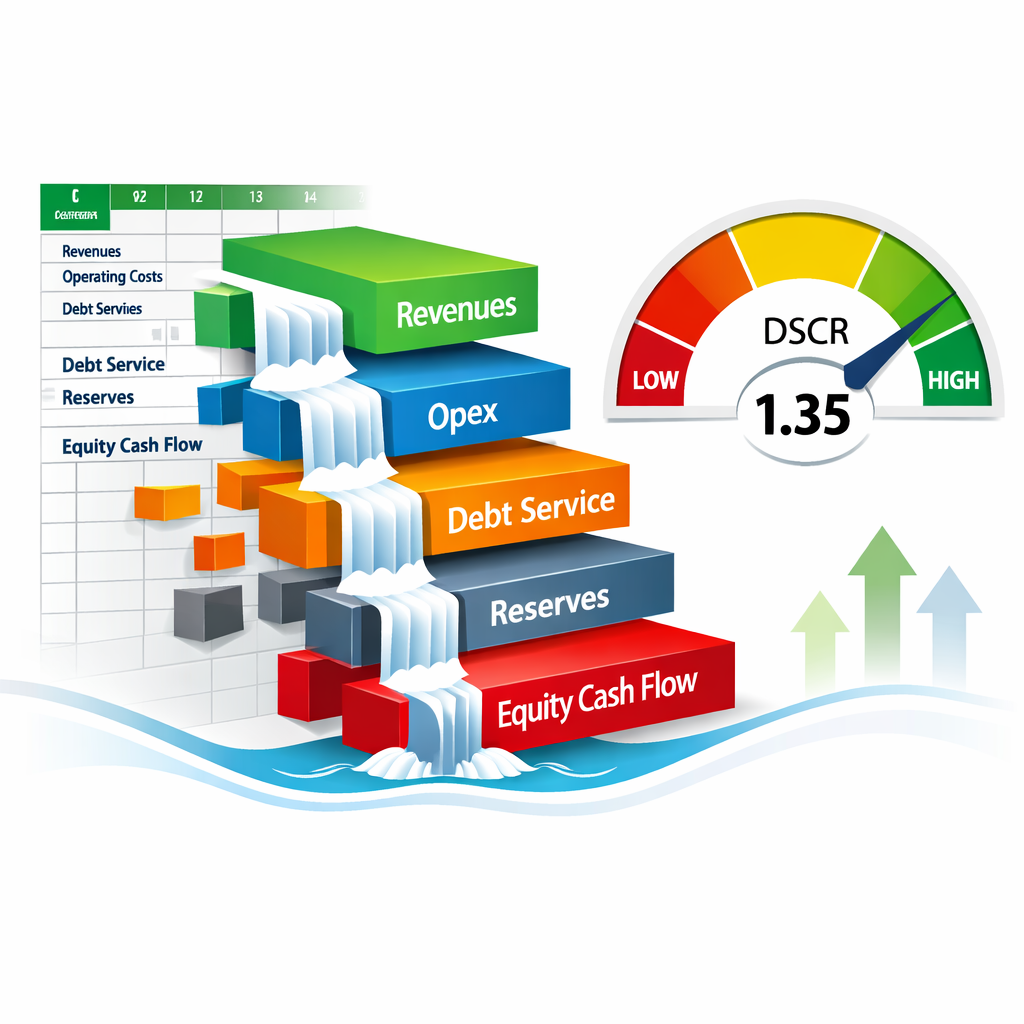
Cash flow discipline remains central to Islamic project finance. Like conventional project financing, Islamic structures depend on controlled accounts, ring-fenced revenues, and an agreed priority of payments.
Shareholder distributions are only permitted after all senior payment obligations have been satisfied and reserve tests have been met
These protections are not weakened by Shari'a compliance. On the contrary, they remain essential to the credibility and bankability of the structure. An Islamic project financing that lacks robust cash flow controls is not merely structurally weak — it may also fail to satisfy Shari'a requirements for proper asset management and sound commercial conduct.
Financial Covenants and Monitoring
Islamic project finance depends on strong covenant protection and ongoing project monitoring. The presence of a Shari'a compliant structure does not alter the fundamental credit disciplines that financiers require.
Ratios such as the debt service cover ratio remain important. Reserve tests, budget controls, reporting obligations, construction monitoring, and operational oversight continue to play a central role in protecting financiers and identifying deterioration at an early stage.
Ongoing Credit Tests
Minimum DSCR thresholds, reserve account balance requirements, budget variance limits, and financial reporting obligations apply throughout the financing life. Breach triggers restricted payment conditions or, in more serious cases, default events.
Construction and Operational Oversight
Technical adviser sign-off on drawdown requests, construction progress reporting, operating performance monitoring, and insurance verification protect financiers against project deterioration or contractor failure throughout the asset's life.
Islamic financing should not be viewed as focused only on formal structure. In serious project finance transactions, it is highly disciplined from a credit and risk management perspective. Sponsors who approach Islamic lenders expecting lighter covenant requirements will find the opposite to be true in market-standard transactions.
Security and Enforcement Considerations
A bankable Islamic project financing still requires a robust security package, even where the legal characterisation of the payment obligations differs from conventional debt.
Direct Asset and Account Protections
Security over project accounts and receivables, charge over physical project assets, assignment of insurance proceeds, and control over cash flows provide financiers with direct recourse to the project's value in a downside scenario.
Rights Over Project Contracts
Assignment of project contracts, share pledge over the project company, direct agreements with key counterparties, and step-in protections allow financiers to take control of, or preserve, the project in a deteriorating situation.
In a downside scenario, financiers need the ability to preserve value, control cash flows, and enforce their rights. While the legal characterisation of the payment obligations may differ from conventional debt, the underlying commercial objective remains the same — effective protection of recoveries and preservation of bankability.
Security structuring in Islamic transactions requires careful alignment with the underlying Shari'a compliant arrangements. Where assets are held by a financier as part of an ijara structure, for example, the security and enforcement mechanics must reflect the financier's ownership position and the lessee's payment obligations. Legal counsel should ensure that the security package is consistent with the Islamic legal structure at every stage — not added as a conventional overlay at the end.
Shari'a Compliance and Documentation Discipline
Islamic project finance requires more than commercial equivalence with conventional structures. It must satisfy Shari'a requirements in both form and substance. This makes documentation and operational execution especially important.
Parties must pay close attention to:
- Transaction sequencing — the order in which steps occur is legally material, particularly in murabaha and istisna structures
- Title transfer mechanics — ownership must genuinely transfer for the structure to be Shari'a valid
- Agency arrangements — the use of the project company as agent to acquire assets must be properly constituted and documented
- Treatment of fees and charges — must not constitute disguised interest payments in substance
- Default mechanics — standard penalty interest cannot apply; alternative arrangements such as charitable donations for delay are used in market practice
- Handling of amounts on non-payment — must not create a benefit that resembles conventional interest accrual
Successful Islamic project financings require close coordination among sponsors, lenders, legal counsel, and Shari'a advisers from the earliest stage of structuring through to financial close.
A common structuring error is to document an Islamic arrangement in conventional terms, then apply a Shari'a overlay at the final stage. This approach is risky. Shari'a compliance is not a checklist applied to a finished document — it is a set of requirements that shape how the transaction is designed from the outset. Involving Shari'a advisers early avoids costly restructuring and reduces the risk of validity challenges at a later stage.
Strategic Benefits for Sponsors and Borrowers
Islamic financing offers several distinct advantages to sponsors and project companies, particularly in markets where Islamic liquidity is commercially significant.
A Broader Investor Universe
Islamic financing attracts institutions that can only participate through Shari'a compliant structures, expanding the available capital pool beyond conventional financiers. In markets where Islamic liquidity is deep, this can materially improve financing capacity and competitive dynamics.
More Resilient Capital Structures
Combining Islamic and conventional tranches reduces concentration risk and can improve the resilience of the overall financing in market stress scenarios. A diversified lender base is a structural advantage for any long-tenor project.
Islamic financing can also improve flexibility in capital structuring and help sponsors create more resilient funding solutions for large-scale projects. It is no longer a secondary option. In many markets — particularly across the Gulf Cooperation Council, Southeast Asia, and North Africa — it is a primary and price-competitive route to capital.
Summary
Islamic financing is now a mature and effective component of modern project finance. It is capable of supporting large, long-term, and technically complex assets across a wide range of sectors and jurisdictions.
When structured properly, Islamic financing combines Shari'a compliance with the essential disciplines of project finance — including controlled cash flows, covenant protection, integrated common terms, and enforceable security.
For sponsors, lenders, and advisers, it is no longer a peripheral option. It is an increasingly important tool in the financing of major infrastructure and industrial projects worldwide.
Frequently Asked Questions
What is Islamic financing in project finance?
Islamic financing in project finance refers to Shari'a compliant funding structures used to finance specific projects through asset-based, trade-based, or investment-based arrangements rather than interest-bearing loans. These structures are designed to align with Islamic legal principles while supporting the commercial requirements of project finance.
Why is Islamic financing suitable for project finance?
Islamic financing is well suited to project finance because both frameworks are linked to real economic activity, identifiable assets, contractual discipline, and predictable cash flows. This makes it possible to structure Shari'a compliant funding within the same bankable framework used for conventional project finance.
What is murabaha in project finance?
Murabaha is a common Islamic financing structure in which a financier purchases Shari'a compliant assets or commodities and sells them to the project company at a deferred price that includes an agreed profit amount. The structure creates liquidity for project purposes without relying on interest-based lending.
Can Islamic and conventional financing be combined in one project?
Yes. Islamic and conventional financing can be combined in a single project financing through a common terms framework. This allows both tranches to share key credit and structural features such as security, covenants, reserve accounts, reporting obligations, and enforcement provisions, while preserving the specific legal mechanics of the Islamic tranche.
What are the main benefits of Islamic financing for sponsors?
Islamic financing can broaden access to capital, diversify funding sources, attract Shari'a compliant financial institutions, and strengthen financing flexibility in markets where Islamic liquidity is important. It can also be integrated into a broader project financing structure without sacrificing bankability.
Does Islamic project finance still require security and financial covenants?
Yes. Islamic project finance typically requires robust security packages, controlled project accounts, reserve mechanisms, financial covenants, and enforcement protections, just like conventional project finance. Shari'a compliance does not remove the need for strong credit discipline.
Chief Financial Officer & CPA (Inactive). Empowering financial professionals with tools, knowledge, and resources to excel.